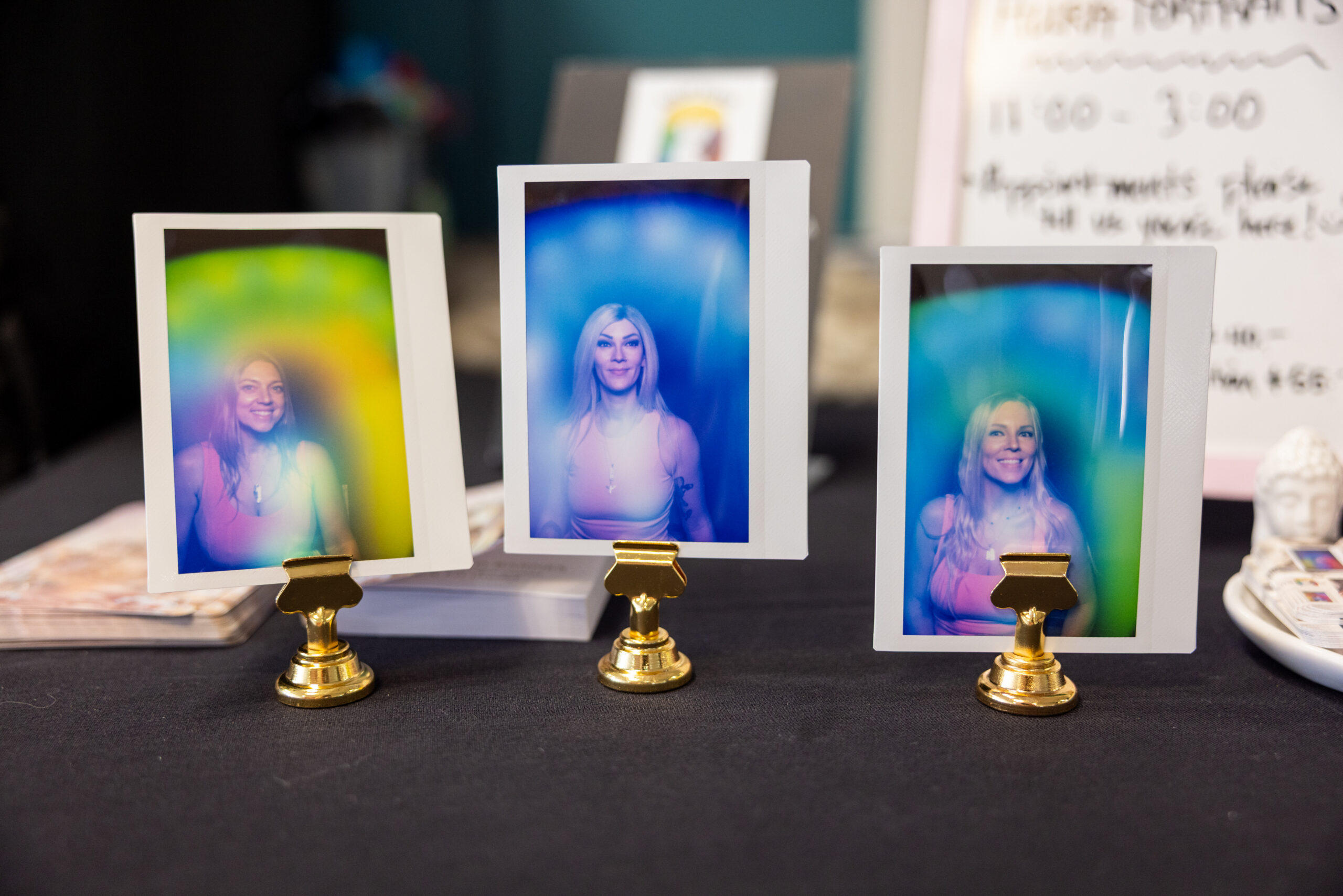
This is usually the first question people ask after their photo develops:
“Okay, but what does my color mean?”
The honest answer?
It’s a little more complicated than looking up “blue aura” or “green aura” on a chart.
In fact, one of the biggest misconceptions about aura photography is that each color has a single fixed meaning. It doesn’t.
If it were that simple, my job would be handing you a laminated cheat sheet and sending you on your way.
Instead, every portrait tells its own story.
The Color Is Just the Starting Point
Yes, colors have general themes associated with them.
Red is often connected to action, vitality, passion, and grounding.
Yellow is frequently linked to confidence, optimism, and personal power.
Blue tends to relate to communication, authenticity, and self-expression.
Green is often associated with growth, healing, and the heart.
Purple can point toward intuition, imagination, and a broader perspective.
But here’s where things get interesting:
A bright, expansive blue can tell a very different story than a small patch of blue mixed with several other colors.
A vibrant green can feel completely different from a muted green.
The color matters.
The context matters more.
Every Aura Portrait Is a Combination
Think about describing a person by only one trait.
She’s funny.
He’s ambitious.
They’re creative.
Technically true.
But not even close to the whole story.
Aura portraits work the same way.
Most people don’t show up as a single color. They have combinations of colors interacting with each other, balancing each other, and sometimes even creating tension with each other.
That’s why two people can have the exact same dominant color and receive completely different readings.
The portrait isn’t asking, “What color are you?”
It’s asking, “What’s happening here?”
Location Matters
One thing many people don’t realize is that where a color appears can be just as important as the color itself.
Different areas of an aura portrait are often interpreted as representing different aspects of your experience. The colors above the head are commonly associated with your current thoughts, focus, or consciousness. Side positions may relate to what you’re expressing outwardly, what you’re processing internally, or the energy you’re bringing in and putting out.
In other words:
A blue above the head might tell a different story than a blue appearing elsewhere in the portrait.
The same color.
Different conversation.
This is one reason why aura photography feels much more like interpreting a map than reading a label.
Bright Doesn’t Mean Good. Dark Doesn’t Mean Bad.
Another common question:
“Is this a good color?”
I’ve got great news.
There are no bad colors.
Seriously.
Every color has strengths.
Every color has challenges.
And every color serves a purpose.
Many aura interpretation systems suggest that clarity, brightness, saturation, and overall balance can provide additional insight, but no color automatically means something positive or negative. Auras are often viewed as reflections of what you’re experiencing rather than a scorecard of how you’re doing.
The goal isn’t to get the “best” color.
The goal is awareness.
So What Does Your Aura Mean?
This is the part where people sometimes expect a definitive answer.
The truth is that aura photography isn’t particularly useful when it’s treated like a personality test.
It’s much more useful when it’s treated like a conversation.
Your portrait becomes a starting point.
A reflection.
A prompt.
A way to explore what’s happening in your life right now.
Sometimes people look at their photo and immediately recognize themselves in it.
Sometimes they’re surprised.
Sometimes the color they expected isn’t there at all.
Those are often the most interesting sessions.
A Quick Color Guide
If you’re looking for a simple starting point, here are some of the most common themes associated with aura colors:
- Red: Grounding, action, vitality, passion
- Orange: Creativity, confidence, adventure
- Yellow: Optimism, personal power, self-expression
- Green: Growth, healing, compassion
- Blue: Communication, authenticity, connection
- Purple/Indigo: Intuition, imagination, insight
- Pink: Love, tenderness, compassion
- White: Clarity, sensitivity, spiritual awareness
But remember:
These are starting points.
Not conclusions.
The Bottom Line
People often come looking for a color meaning.
What they usually leave with is a deeper understanding of themselves.
The color catches your attention.
The conversation creates the insight.
And that’s why, after thousands of aura portraits, I still don’t believe the most important question is:
“What does this color mean?”
A better question might be:
“Why does this part resonate with me right now?”
That’s where the real story usually begins.